

Last updated : June 23, 2026 | Written & Reviewed by Advanced Team
What are Intrusive Thoughts and How to Manage them?
Have you ever witnessed a state in which your mind is continuously trying to warn you about something? Or, do you feel yourself acting on an assumption that is far from reality?
If yes, you might be experiencing intrusive thoughts!
Intrusive thoughts are verbal thoughts or impulses that occur repetitively. They are uncontrollable thoughts with an internal origin and interrupt daily life activities. Mostly, these thoughts are harmless and do not necessarily reflect a person’s intentions or desires. However, these thoughts tend to stick in your mind and often repeat themselves, even when you try to forget them. It ultimately disturbs our thinking process, affects our lives, and causes a lot of stress.
Acknowledging these thoughts can help reduce their impact. As when these thoughts become regular, it causes distress or disrupt everyday life, and one may require professional support. Also, excessive stress and anxiety can trigger or worsen intrusive thoughts.
The Science Behind the Intrusion
Intrusive thoughts are undesirable, unintended thoughts that can pop into your mind without any specific reason. These thoughts severely disturb an individual’s life and can take on many forms, including violent or sexual imagery. However, these thoughts are not necessarily a sign of mental illness, though they can be linked to certain mental health conditions. In fact, everyone experiences them at some point. These thoughts can be persistent and distressing. These thoughts can seem impulsive, but the truth is that they are just thoughts and don’t necessarily mean anything. Anyone can experience this condition, regardless of their age and gender.
Imagine you are trying to focus on an important thing, like preparing for a presentation at work, but these intrusive thoughts keep disturbing you. These may be that you think you are going to lose confidence during the presentation, or you will say something wrong. They can even make it impossible for you to continue your daily tasks. It can lead to repetitive doubts about relationships, judgments, small and large, sexual orientation, or identity. However, these thoughts often focus on sexual, violent, or socially unacceptable images.
Examples of Intrusive Thoughts
You’re keeping up your schedule, and unexpectedly, you’re hit with a thought that’s weird, uncomfortable, even surprising. Maybe you’re talking to someone, and you suddenly picture yourself punching them in the face. Or you can’t stop thinking about what if I didn’t revise my whole syllabus and failed the exam? You don’t want to think about this stuff, so why does it keep happening? Then definitely these are intrusive thoughts, and everyone faces them from time to time. Usually, people overlook these thoughts and move on. But sometimes, they become out of control.
What is the Prevalence of Intrusive Thoughts?
One study of intrusive thoughts, involving university students from 13 countries, across six continents, found that almost everyone (93.6 percent) experienced these thoughts at least some of the time. Research has found that almost all new mothers have these invasive thoughts of harm happening to their baby, and around one-half of them have had thoughts of intentionally harming their baby (Fairbrother and Woody, 2008).
According to research by the National Institute of Medicine, around 6 million people in the United States are troubled by these unwanted thoughts because they feel so threatened.
Why Do Intrusive Thoughts Occur?
These thoughts don’t appear with a clear reason. They can just happen randomly. Some thoughts develop in your brain. Then just as quickly, they exit, leaving no lasting impression. People rarely act on their thoughts because they are surprising and inappropriate. In certain people, repetitive thoughts may be recurrent and cause severe distress. The more individuals attempt to relieve these feelings, the more persistent and powerful they become. Generally, these thoughts are related to an underlying mental health condition, like obsessive-compulsive disorder (OCD) or post-traumatic stress disorder (PTSD). These thoughts could also be a symptom of another health issue, such as:
- Decline in mental abilities
- Any accidental injury to the brain
- Stress & burnout
- A symptom of Parkinson’s disease
- Anxiety
- Sleep deprivation
- Hormonal changes
- The brain’s threat-detection system
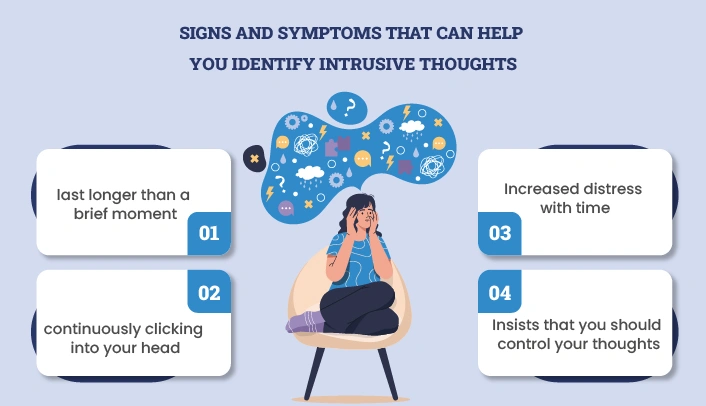
Here are some of the signs and symptoms that can help you identify underlying mental health conditions:
- last longer than a brief moment
- continuously clicking into your head
- Increased distress with time
- Insists that you should control your thoughts
How Intrusive Thoughts Feel Like?
When intrusive thoughts occur, you might feel distressed, but having an intrusive thought once in a while is a normal part of life. Sometimes these thoughts can be difficult to cope with. You might think about hurting yourself or someone else. Mostly, there’s no serious reason behind it. You don’t actually want to do those things; it’s just a random impulse that appears in your mind.
What are the Types of Intrusive Thoughts
It is important to know that unwanted thoughts are uncontrollable. Mostly, they occur as a result of underlying mental health conditions. However, they also appear in various other disorders, including substance use disorders, depression, post-traumatic stress disorder, and anxiety disorders, as well as in healthy individuals.
The following are some of the types:
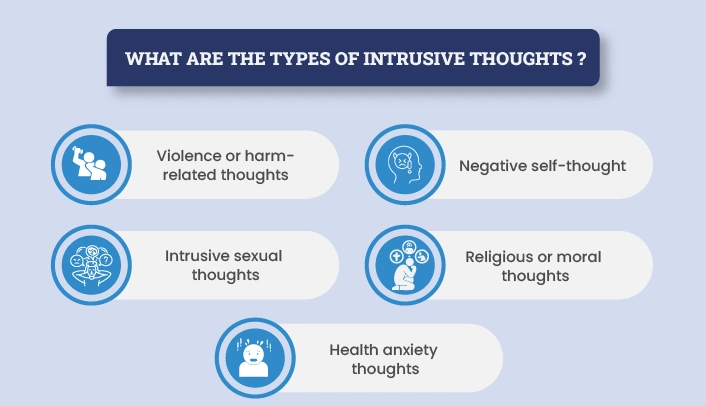
1. Violence or Harm-Related Thoughts
These are the thoughts about hurting yourself or others, imaginations of accidents or violence, or desires to do something dangerous. For example, thinking “What if I pushed someone off this platform?” while waiting for a train. These thoughts do not reflect desire or intent.
2. Intrusive sexual thoughts
Undesirable sexual thoughts, impressions, or urges that feel problematic or upsetting. These might involve taboo scenarios, inappropriate people, or content that conflicts with the person’s sexual orientation or values.
3. Negative self-thought
Thoughts questioning your competence, worth, or identity. These might include “What if I am not who I think I am?” or “What if I secretly want to do bad things?” Self-doubt and intrusive thoughts often target what matters most to the person.
4. Religious or moral thoughts
For religious individuals, these intrusive beliefs might involve blasphemous ideas, doubts about faith, or images that violate religious teachings. These can be especially distressing for people whose faith is central to their identity.
5. Health anxiety thoughts
Unwanted thoughts about illness, contamination, or physical symptoms. These might include persistent worry that something is medically wrong despite reassurance, or distressing images of disease and death.
How Intrusive Thoughts and Mental Health Disorders are Linked?
If your thoughts are the reason behind your stress or impacting your daily life, it could be a sign of a mental health condition.
Sometimes these thoughts arise as a result of an underlying mental health disorder, such as obsessive-compulsive disorder, where thoughts become so irritating that they result in repetitive behaviors or compulsions to try to prevent them from occurring. They are also common in post-traumatic stress disorder, which can be caused by a life-threatening or extremely stressful event, such as an accident or violent attack. Whereas many people experience these thoughts but don’t have a mental health disorder. Here are some of the mental health disorders that are linked with intrusive thoughts:
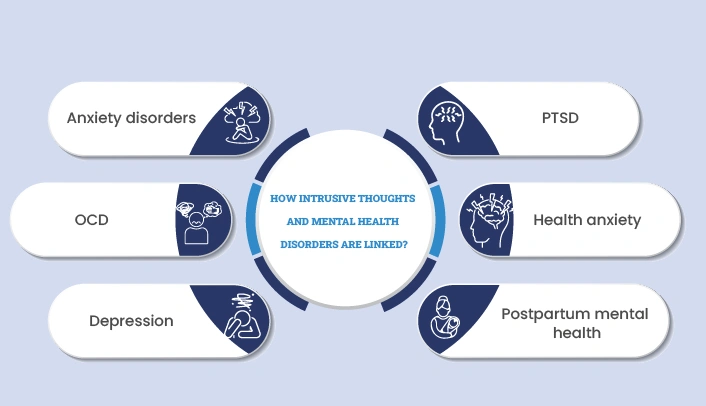
1. Anxiety Disorders
Thoughts like these may be a result of an anxiety attack, such as obsessive-compulsive disorder (OCD).
- Excessive anxiety and rumination
- Constant need for certainty
2. Obsessive Compulsive Disorder (OCD)
- Obsessions and compulsions
- Checking, reassurance-seeking, avoidance behaviors
3. Depression
Changes to mental health in depression are nothing to take lightly. Depression may be followed by invasive thoughts through the following effects:
- changes in cognitive patterns
- Compulsive thinkings
- thoughts of disturbing imagery
- Self-critical and unproductive thoughts
- Feelings of guilt and shame
4. Post-Traumatic Stress Disorder (PTSD)
Flashbacks and trauma-related thoughts after a serious life event.
5. Health Anxiety
Persistent fears about illness and safety related to a specific disease. For example, a cancer patient who knows about his health conditions will develop these thoughts, which can further deteriorate the condition.
6. Postpartum Mental Health Conditions
Mothers experiencing postpartum depression may develop intrusive thoughts, which may include the following.
- These thoughts experienced by new mothers are related to their baby’s health.
- Intrusive ideas during postpartum about body shaming and weight management
When these thoughts are related to an underlying condition, like OCD or PTSD, getting started with a diagnosis and treatment may take some time. While sticking to your treatment plan can help ease symptoms and make the thoughts less frequent. Options like medication and CBT can help you cope with the thoughts when they do happen.
Factors Contributing to Intrusive Thoughts
These thoughts are often opposite to a person’s values and interests; therefore, they arise from a combination of biological, environmental, and psychological factors, not from a single cause. The following are some factors that contribute to the development of these thoughts.
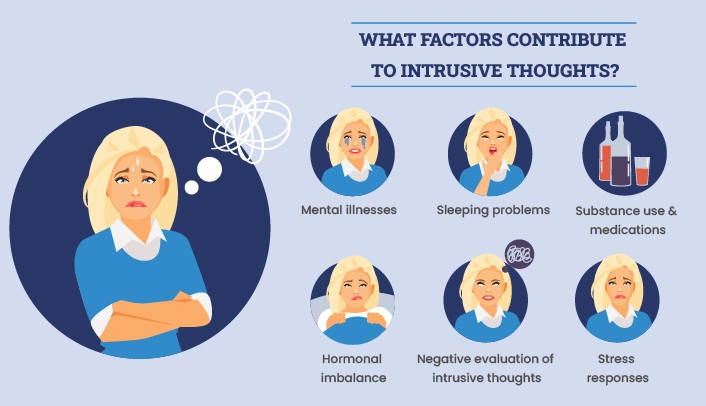
- Stress and Life Complications
- Mental illnesses(OCD & GAD)
- Sleeping Problems
- Hormonal Imbalance
- Negative Evaluation of Intrusive Thoughts
- Stress Responses
- Substance Use & Medications
- Biological & Genetic Factors
- Personality Traits
Normal Thoughts Vs Intrusive Thoughts
Anyone can experience instructive thoughts; these thoughts themselves are not a problem, but sometimes they can turn into distressing obsessions and possibly obsessive-compulsive disorder. It can urge one to that level where they can clash their values. On the other hand, normal thoughts are deliberate, manageable, and align with your core values. The key difference lies not in the content of the thought, but in how the brain reacts to it.
| Normal thoughts | Intrusive thoughts |
| Normal thoughts are intentional thoughts that one brings up themselves. | They suddenly pop up randomly without warning |
| These are purposeful thoughts that make one decide what they want to think about. | These thoughts are often hard to suppress or dismiss instantly. |
| Normal thoughts are practical or reflective of the actual desires and plans. | These invasive thoughts are damaging, taboo, and highly out-of-character |
| Easily go away on its own | It leads to immediate anxiety, shame, or intense unease because they clash with actual values. |
These thoughts occurring independently of just intention are symptoms of obsessive-compulsive disorder (OCD). However, they also appear in various other disorders, including substance use disorders, depression, post-traumatic stress disorder, and anxiety disorders, as well as in healthy individuals.
How Intrusive Thoughts Impact Daily Life?
It severely affects day-to-day life, as the more you think about intrusive ideas, the more anxious you might become and dwell on them even more. The thought feels hard to control. Intrusive beliefs are often repetitive and won’t go away, and will impact daily life as follows.
- Emotional Distress
- Embarrassment and low self-blame
- Lack of Concentration
- Sleeping disorders
- Relationship Pressure
- Social Distancing
How to Diagnose Intrusive Thoughts?
The first step in understanding intrusive thoughts is discussing your symptoms with a mental health provider. They review your medical history, may perform a physical exam, and may use questionnaires or screening forms. If no physical cause is found, you may be referred to a licensed mental health professional to evaluate conditions commonly linked to the development of these thoughts, such as obsessive-compulsive disorder (OCD) and post-traumatic stress disorder (PTSD).
1. Treatment Approaches
These thoughts are nothing to not talk about or hide, but they are a reason to seek a diagnosis and treatment so that you can start to feel better. Invasive thoughts can feel distressing, but if one occurs once in a while, it’s probably nothing to be concerned about. In many cases, they are not caused by anything in particular. By recognizing that it’s only a thought, you can help yourself move past it. A mental health professional diagnoses the exact causes and then designs treatment tailored to the unique needs of an individual. They sometimes offer a combination of treatments in order to get accurate results.
2. Medications
Medications are usually effective for treating intrusive beliefs that occur because of mental health conditions. Some of the common medications include Selective Serotonin Reuptake Inhibitors (SSRIs), antipsychotics, and antianxiety medications, which are often prescribed by a healthcare professional. Medication is often most effective when combined with therapy.
3. Therapies
When you are unable to overcome intrusive ideas on your own, mental health experts offer therapies that can help. A few types may be especially beneficial for treating intrusive thoughts associated with mental health conditions.
-
Cognitive Behavioral Therapy (CBT)
This structured, goal-oriented therapy can help with anxiety and obsessive-compulsive disorder(OCD), two mental health conditions that can bring intrusive beliefs. It helps by changing the thought pattern by intervening in the thoughts.
-
Exposure and Response Prevention (ERP)
ERP is the gold standard treatment for OCD and intrusive thoughts. It involves deliberately exposing yourself to triggers while resisting compulsive responses. This teaches the brain that the thoughts are not dangerous and do not require action. Through this specific type of CBT, a therapist guides you in gradually increasing your exposure to the things or ideas that trigger your anxiety, fear, and trauma.
-
Acceptance and commitment therapy (ACT)
The goal of ACT is to help you reframe your relationship with your thoughts, especially intrusive ones. A therapist will help you learn techniques (including cognitive defusion) to help you better understand and manage your thoughts. ACT focuses on accepting thoughts and feelings rather than fighting them, while committing to values-based action. It is particularly helpful for learning to live with uncertainty.
Get Professional Assistance at Advanced Health Preference Group
Advanced Health Preference Group offers proven medical treatments for various mental health conditions. Our experts provide thorough health checks and create custom care plans for every patient. Our services include:
- Talk Therapy: We offer both individualised sessions and group settings to help you change your thoughts.
- Psychiatric Medication Management: Our mental health experts manage your prescriptions and closely monitor your health.
- Stress Relief: We teach useful skills to keep you calm during challenging moments.
- Family Help: our expert team offers therapy and guidance for the people closest to you.
- Education: We teach both patients and their families how to manage this condition.
Our team helps you heal by offering compassionate treatments. We use recent research and comprehensive care to help you manage these thoughts, help you regain and repair broken relationships, and improve your mental health.